 ENG
ENG
 INA
INA
Becoming the Fastest Graduate, Sukarta Earns Doctorate in Environmental Science University General
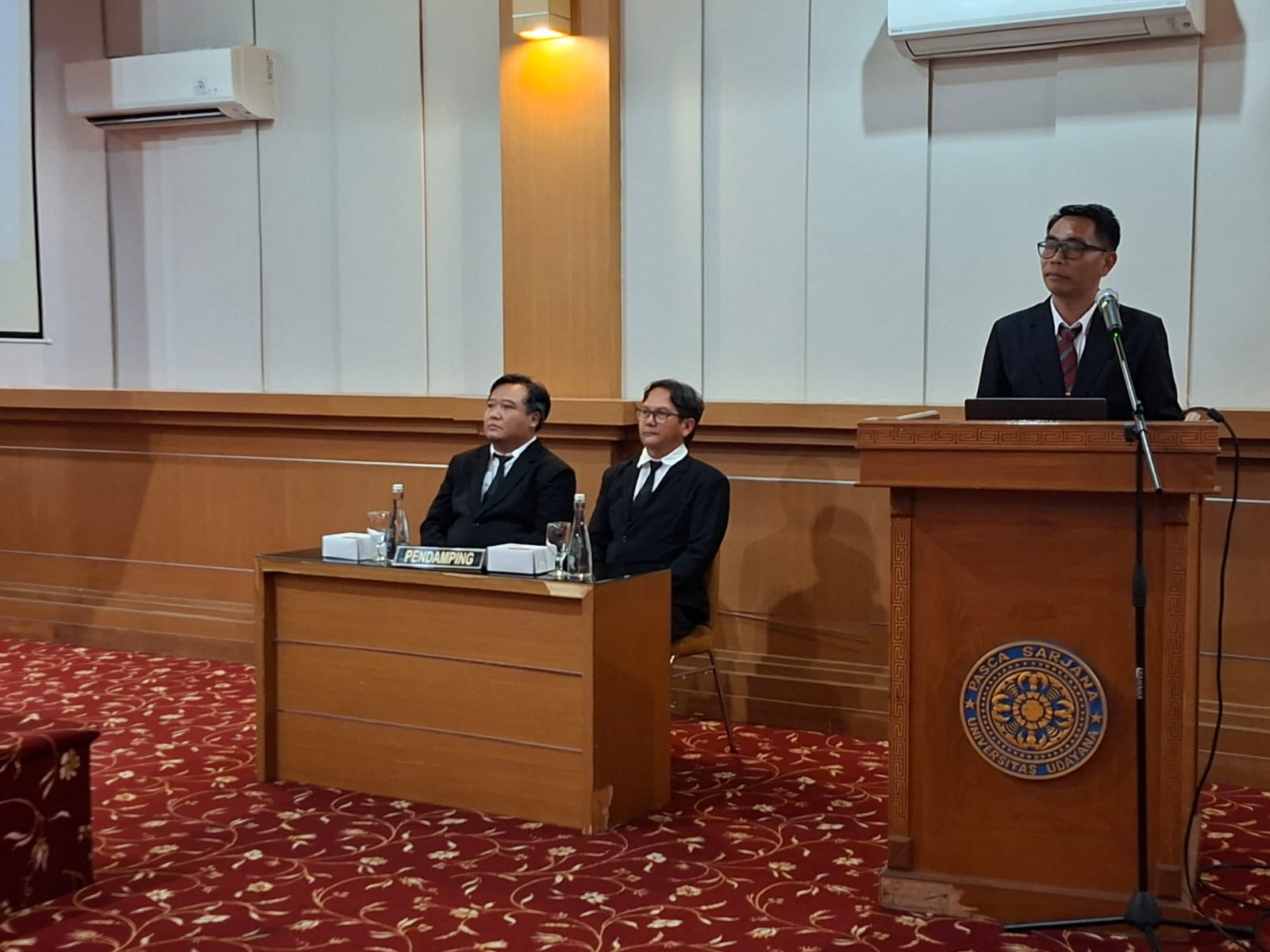
Denpasar, Thursday (January 8, 2026), the Doctoral Program in Environmental Science (PDIL) at the Graduate School of Udayana University (Unud) held the Second Stage Final Examination (Open Examination) with Promovendus I Nyoman Sukarta, S.Pd., M.Si., which took place in the Auditorium of the Graduate School Building at Udayana University. Sukarta successfully defended his dissertation entitled “Development of a Zero Waste Photocatalysis-Based Liquid Waste Treatment System for the Textile Industry Using Hydroxyapatite Nanoparticles from Oyster Shell Waste (Crassostrea spp.)” in front of the examiners and academic guests. The doctoral promotion examination was led by the Coordinator of PDIL Postgraduate Program at Udayana University, Prof. I Wayan Arthana, MS., PhD., and consisted of seven examiners, namely Prof. Dr. Drs. I Wayan Budiarsa Suyasa, M.Si., Prof. Dr. Ir. I Gede Mahardika, M.S., Prof. Dr. Ir. I Nyoman Rai, MS, Prof. Dr. Ir. I Wayan Suarna, MS, Dr. Drs. I Made Sara Wijana, M.Si., Dr. Ni Made Suartini, S.Si., M.Si., and Dr. Drs. Manuntun Manurung, MS, as well as three academic guests, namely Dr. Pande Gde Sasmita Julyantoro, S.Si., M.Si., Dr. Ni Made Suartini, S.Si., M.Si., and Dr. Nyoman Dati Pertami, S.P., M.Si.
In his presentation, Sukarta revealed that small-scale and household textile industries in Indonesia are the main contributors to water pollution because they produce thick liquid waste containing complex cationic organic compounds that are toxic and difficult to degrade biologically. He added that this study aims to develop a textile liquid waste treatment system based on photodegradation using hydroxyapatite-TiO₂ (HAP-TiO₂) nanocomposite catalysts synthesized from oyster shell waste (Crassostrea spp.). The results show that the system is capable of reducing color concentration/intensity by up to 99.9%, TDS by up to 80%, TSS by up to 88.5%, BOD to 5.04 mg/L, COD to 16.00 mg/L, phenol to undetectable levels, and NH₃-N by >98%. The pH value also remained stable in the neutral range (pH 7), reflecting an environmentally friendly and safe reaction. However, the final TSS value was still 92 mg/L, exceeding the national quality standard (≤50 mg/L), indicating the need for an additional final filtration unit. These findings prove that the developed treatment system is effective, based on biogenic waste, and environmentally friendly and has great potential for adoption in small-to-medium-sized textile industries, with minor improvements needed to achieve full compliance with environmental standards, concluded Sukarta in his presentation.
Meanwhile, at the end of the open examination, the promoter, Prof. Dr. Drs. I Wayan Budiarsa Suyasa, M.Si., gave a speech about the meaning of the dissertation. Starting his speech, Prof. Budi congratulated Nyoman Sukarta for completing his studies at PDIL Pasca Unud in five semesters. Additionally, congratulations were also extended to the family and the institution where the doctoral candidate works. Prof. Budi added that the core of this research lies in materials chemistry, waste management techniques, and environmental management. The future challenges to be addressed pertain to the technical aspects of developing prototypes, scaling them up, and optimizing them to continue further research, Prof. Budi noted (DK).
UDAYANA UNIVERSITY